Marine vs Bovine Collagen: Which Is Better?
Marine or bovine collagen? We compare source, collagen types, taste, price and who each suits – and why bone broth is the tastier way to get bovine collagen plus protein.
In this guide
Marine or bovine? Stand in front of the collagen shelf for long enough and you’ll start to feel like you’re choosing a mortgage. Fish or cow. Tubs or sachets. Prices that make your eyes water.
Sound familiar? You just want to know which one to buy, and whether you’ll actually enjoy using it every morning. Because the best collagen in the world is useless if it sits at the back of the cupboard smelling faintly of the harbour.
Here’s the plain-English version: what each one is, how they differ, who each suits, and why we think most people are better off with the beefy one – ideally in a mug.
What is collagen, in one breath?
Collagen is the most abundant protein in animal bodies. It’s the stuff in skin, bones, tendons and cartilage. Supplement collagen is usually “hydrolysed”, which just means it’s been broken down into smaller pieces (peptides) so it dissolves easily. There are lots of collagen types, but the two you’ll see on labels most are type I and type III.
Marine collagen: the fishy one
Marine collagen is made from fish – usually the skin and scales left over from fish processing. Scientific reviews describe fish collagen as predominantly type I, because type I is the main collagen in skin. It’s popular with pescatarians and people who don’t eat beef for cultural or religious reasons.
The catch? It’s fish. Fish is one of the 14 major allergens in UK food law, and allergy researchers have found that fish collagen itself can trigger reactions in some fish-allergic people – even after heating. Then there’s the smell. Plenty of people find unflavoured marine collagen has a faint fishy note, which is fine in a smoothie and less fine in your morning coffee. And marine collagen often sits at the pricier end of the shelf.
Bovine collagen: the beefy one
Bovine collagen comes from cows – typically hides and bones. It mostly gives you type I collagen, with type III alongside it. It tends to be easier on the wallet, and it’s much more neutral to taste and smell.
Most bovine collagen powders are still just that, though: an isolated powder. You get collagen and not much else. Which leads us to the question nobody on the collagen shelf is asking.
What if you didn’t need a collagen tub at all?
People have been getting collagen the whole-food way for centuries: by simmering bones. Bone broth is where bovine collagen comes from in the kitchen, long before anyone put it in a tub. Slow-simmer beef bones and the collagen comes out into the broth, along with the rest of the protein.
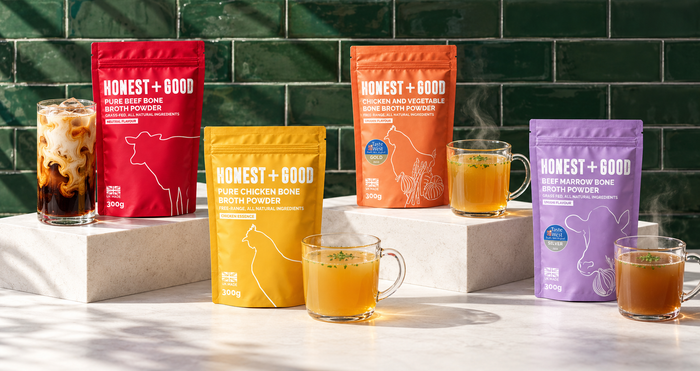
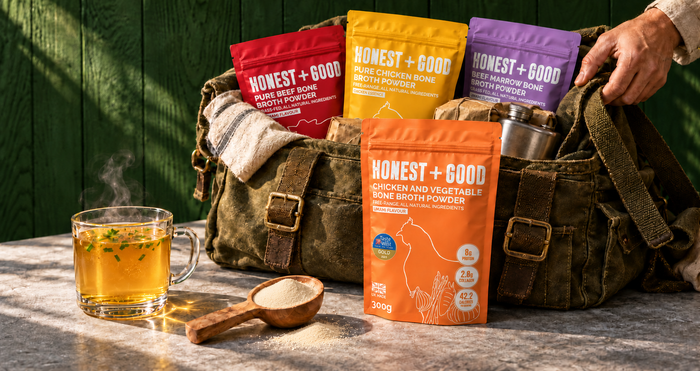
That’s exactly what our Pure Beef Bone Broth Powder is: 99.8% grass-fed British beef bone broth, dried into a fine powder (the other 0.2% is sunflower lecithin so it mixes smoothly). One 10g tablespoon gives you 8,500mg of collagen and 9.6g of protein. No added salt. No fishy whiff. Dairy-free and free from the 14 major allergens.
And because it’s neutral in flavour, it doesn’t just go in a mug. It goes in your coffee, your porridge, your soups, your bolognese. Protein contributes to the growth and maintenance of muscle mass and to the maintenance of normal bones – and Pure Beef is high in protein, so it’s pulling more weight per spoon than a collagen-only powder.
Marine vs bovine vs bone broth: side by side
| Marine collagen | Bovine collagen powder | Pure Beef Bone Broth Powder | |
|---|---|---|---|
| Source | Fish skin and scales | Cow hides and bones | Grass-fed British beef bones, slow-simmered |
| Collagen types | Mainly type I | Types I and III | Bovine collagen, naturally from bone broth |
| Collagen per serving | Varies by brand | Varies by brand | 8,500mg per 10g |
| Taste and smell | Can be faintly fishy | Mostly neutral | Neutral, gently savoury |
| Fish allergen | Yes | No | No – free from the 14 major allergens |
| Cooks into food | Best in sweet drinks | Drinks, mostly | Coffee, soups, sauces, porridge, eggs |
| Whole food? | No, isolated powder | No, isolated powder | Yes – just bone broth |
| Suits | Pescatarians | Meat eaters wanting collagen only | Anyone who eats beef and wants collagen plus protein |
So which is better?
If you’re pescatarian, marine collagen is the one that fits your plate. If you have a fish allergy, skip it altogether and speak to your GP if you’re unsure about any supplement.
For everyone else, we’d pick bovine – and we’d pick it in bone broth form. Here’s why:
- It tastes of nothing fishy. You’ll actually use it, every day, in things you already eat.
- You get protein too. 9.6g per tablespoon, with 19 amino acids.
- It’s food, not a lab powder. One ingredient doing the heavy lifting: grass-fed British beef bone broth.
- It cooks. Stir it into a sneaky bolognese or a broffee and nobody’s any the wiser.
- It’s British. Made from British beef, tested every batch – you can see the test results.
How much collagen is in each H+G broth?
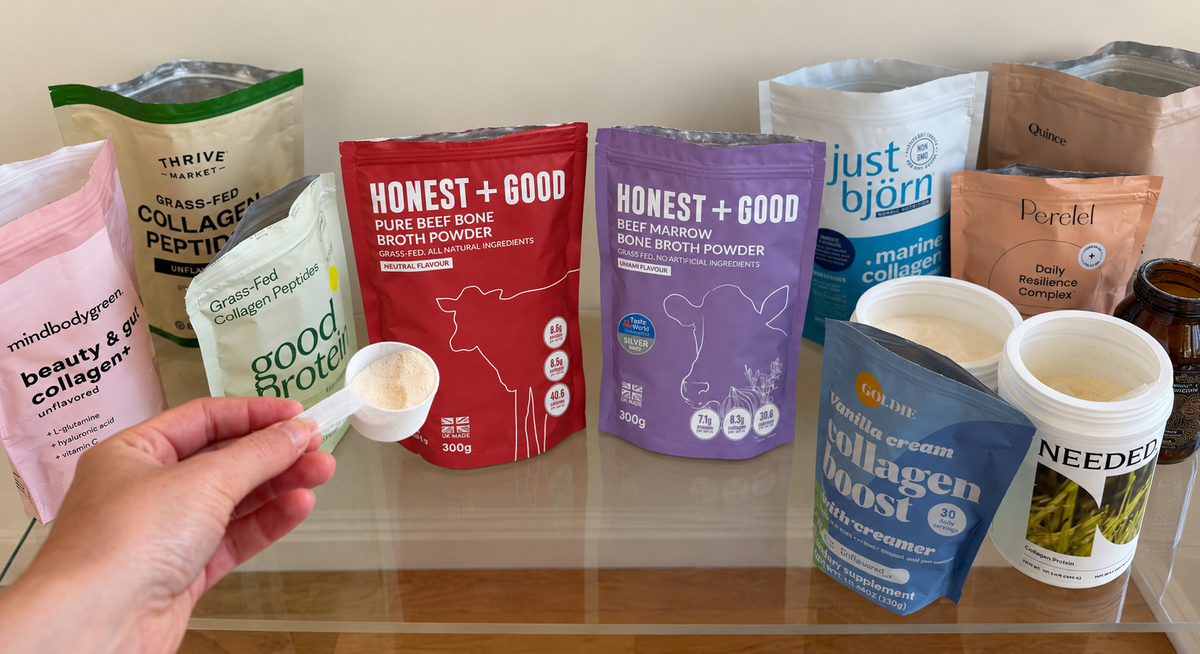
If collagen per spoon is your thing, here’s how our range stacks up per 10g serving.
Pure Beef is the collagen champion of the range. Fancy something seasoned and sippable? Beef Marrow, with rosemary, thyme and sea salt, still brings 6,500mg per serving.
Questions people ask
What is the difference between marine and bovine collagen?
Marine collagen comes from fish and is mainly type I. Bovine collagen comes from cows and gives you types I and III. Bovine is usually more neutral in smell and kinder on the budget.
Is bovine collagen better than marine collagen?
For most people who eat beef, we think so: no fishy taste, no fish allergen, usually better value. Get it from bone broth and you get protein too.
Can I take marine collagen if I’m allergic to fish?
Fish is one of the 14 major allergens, and research shows fish collagen can be a problem for some fish-allergic people. Ask your GP or allergy specialist before trying it, or choose a beef option instead.
Does marine collagen taste fishy?
Unflavoured marine collagen can have a slight fishy taste or smell. Many people hide it in smoothies. Pure Beef is neutral, so it goes in coffee, soups and sauces without a trace.
Is bone broth a good source of collagen?
Yes – bone broth is where collagen naturally comes from in the kitchen. Our Pure Beef Bone Broth Powder gives you 8,500mg of collagen in every 10g tablespoon.
Can you mix bovine collagen into hot drinks?
Yes. Pure Beef dissolves into hot coffee, tea and soups. See 7 easy ways to use bone broth powder for ideas.
Our pick
If you want collagen without the fishy morning, go for Pure Beef Bone Broth Powder. 8,500mg collagen and 9.6g protein per tablespoon, from grass-fed British beef, with no added salt. 30 servings in every pouch, and it disappears into just about anything you cook.
Shop Pure Beef Bone Broth Powder →
Related Reading
- Bone broth benefits
- Grass-fed vs grain-fed beef
- How much bone broth a day?
- The UK guide to bone broth powder
Sources & Further Reading
- Silva et al. (2014), Marine Origin Collagens and Its Potential Applications, Marine Drugs
- Barzkar et al. (2023), Marine collagen: purification, properties and application, Frontiers in Marine Science
- Kobayashi et al. (2016), Allergy to fish collagen, Allergology International
- Food Standards Agency, Food allergy and intolerance advice for consumers